What should a lesson plan include?
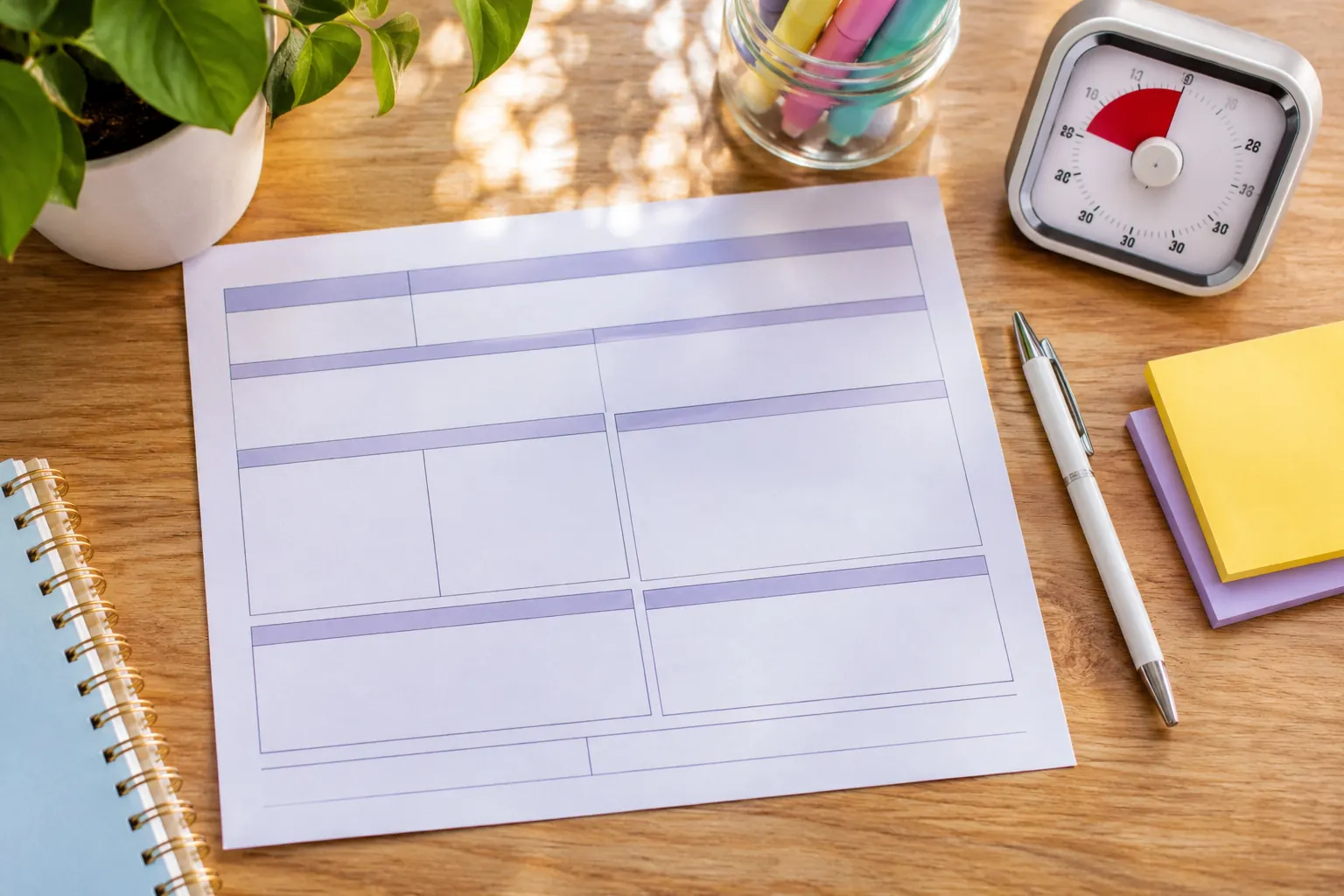
A lesson plan should include a clear objective, the materials you need, a timed sequence of activities, a way to check understanding and a plan for closure or homework. Formats vary by school and district, so treat the components below as a core you can map onto any required template.
| Component | Purpose | Question it answers |
|---|---|---|
| Learning objective | States what students will be able to do by the end of class | What will students learn? |
| Success criteria | Describes what a strong answer or product looks like | How will students know they got it? |
| Materials | Lists texts, handouts, lab supplies and slides | What do I need ready before class? |
| Warm-up | Activates prior knowledge in the first few minutes | What do students already know? |
| Direct instruction | Introduces the new concept or skill | How will I teach it? |
| Guided and independent practice | Gives students time to apply the idea, first with support, then on their own | How will students practice? |
| Check for understanding | Collects evidence of learning before students leave | Did they learn it? |
| Closure and homework | Summarizes the lesson and extends practice | What comes next? |
How do you write a lesson plan step by step?
Work backward from the goal: decide the outcome, then the evidence, then the activities. The University of Toronto's summary of Wiggins and McTighe's Understanding by Design describes the same order as identifying desired results, determining acceptable evidence and only then planning learning experiences and instruction.
01 Identify the goal
Read the textbook section or unit plan and name the one or two big ideas students must leave with. If your school requires a standard, copy it word for word from the official document.
02 Write a measurable objective
Phrase it as what students will be able to do, with an action verb such as explain, compare, calculate or classify. Avoid verbs like understand that you cannot observe.
03 Decide the evidence
Choose how students will show the objective: an exit ticket, a short quiz, a labeled diagram or a one-paragraph explanation. Write that question or task now, before you plan activities.
04 Plan the warm-up
Open with a three-to-five-minute task that connects to prior knowledge or surfaces misconceptions, such as one question on the board.
05 Plan instruction and practice
Keep direct instruction focused, move to guided practice while you circulate, and finish with independent or partner work that mirrors the evidence task.
06 Set the timing and materials
Assign minutes to each segment so the total fits the period, and list every handout, slide and supply you need.
07 Plan closure and reflect
End with a summary and the check for understanding, assign homework if it serves the objective, and leave space to note what to change next time.
How do you write a good learning objective?
A good learning objective is student-centered, measurable and built on an action verb. Carnegie Mellon's Eberly Center advises that objectives describe what students should be able to do, use action verbs, and draw on Bloom's taxonomy as a starting list of verbs.
Compare students will understand photosynthesis with students will explain how plants use light, water and carbon dioxide to make sugar. The second version tells you exactly what to assess and tells students what success looks like.

How do you check for understanding during a lesson?
Check for understanding at least once mid-lesson and once at the end, using quick tasks that every student answers. Edutopia's Rebecca Alber describes the exit slip as a short response students write at the conclusion of learning, sometimes on a half-sheet with sentence starters, which the teacher then collects.
Mid-lesson checks can be as simple as mini whiteboards, a thumbs-up scale or one multiple-choice question answered with hand signals. Sort exit tickets into got it, almost and not yet, and let those piles shape the next day's warm-up.

How long should each part of a 45-minute lesson take?
A practical split for a 45-minute class gives roughly a quarter of the time to direct instruction and most of the rest to practice and checking.
Treat these numbers as a starting point, not a rule. Labs, discussions and test reviews need different splits, and a plan that runs long is a signal to cut content rather than closure.
- Warm-up: 5 minutes
- Direct instruction: 10 to 12 minutes
- Guided practice: 10 minutes
- Independent or partner practice: 10 to 12 minutes
- Check for understanding and closure: 5 to 8 minutes
What are common lesson planning mistakes?
Most lesson planning mistakes come from planning activities before deciding what students should learn. A consistent template, reused every week, catches the rest before class starts.
- Choosing activities first and writing the objective afterward to fit them.
- Writing objectives with verbs like know or understand that cannot be observed.
- Planning more content than the period can hold, which squeezes out practice and closure.
- Skipping the check for understanding, so the next lesson rests on guesses.
- Forgetting materials or setup time for labs and group work.
Can CourseSmith help you write lesson plans faster?
CourseSmith, an AI teaching assistant built by SuperMIA, drafts lesson plans from the textbook you upload. You upload a textbook PDF or DOCX, CourseSmith organizes it into chapters and topics, and you pick a topic, one or more delivery methods and the lecture length in minutes.
Each draft includes learning objectives, an in-depth explanation of the topic, a step-by-step delivery plan for each method, homework and a project idea. A teaching persona shapes drafts to match how you teach, and because CourseSmith is an assistant, you still add your own warm-up and check for understanding and fact-check every plan.